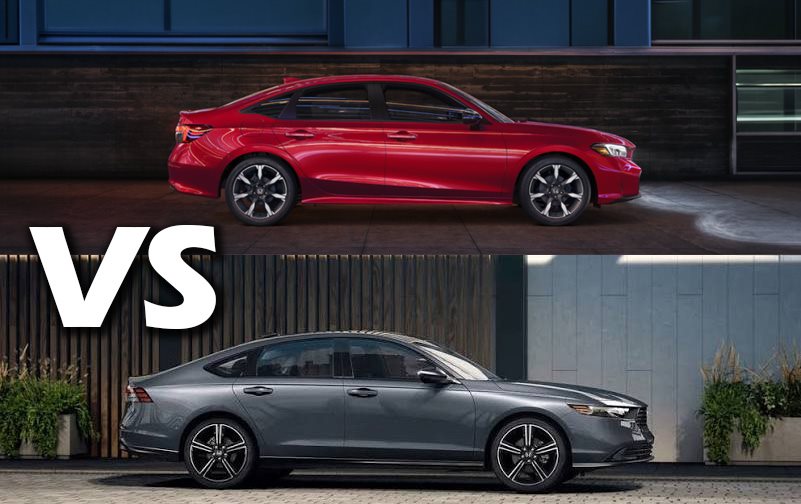
Compare the 2026 Honda Civic and 2026 Honda Accord for your best match
The 2026 Honda Civic and 2026 Honda Accord are both easy sedans to recommend for everyday driving, but they solve slightly different problems. The Civic is smaller, more efficient, easier to maneuver, and less expensive to buy, while the Accord gives you substantially more rear-seat room, a larger trunk, and a more spacious midsize-sedan experience. Both are available with efficient hybrid powertrains, and both offer the driver-assistance features people increasingly expect from a modern commuter.
For drivers around Youngstown and Boardman, the choice comes down to how much of the Accord's additional space you will actually use and which powertrain best fits your driving.
How Much Space Do You Actually Need?
The 2026 Civic Sedan is 184.8 inches long, while the Accord stretches to 195.7 inches. Nearly 11 inches may not seem particularly important until you are pulling into a crowded parking lot, fitting the car into a garage, or navigating busy commercial areas along Route 224. Despite its smaller footprint, the Civic still provides 42.3 inches of front legroom, the same published figure as the Accord, along with a useful 14.8 cubic feet of trunk space.
Most of the Accord's size advantage shows up behind the driver. It provides 40.8 inches of rear legroom compared with 37.4 inches in the Civic, and trunk capacity increases to 16.7 cubic feet. That additional room is easier to appreciate when adults or taller teenagers regularly occupy the rear seats, or when several people need to bring luggage on a longer trip.
For a car that mostly carries one or two people, the Civic is a great choice. If the rear seats regularly carry passengers or this sedan will double as the household road-trip car, the Accord's additional space will come in handy.
The Civic Hybrid Is the Performance Surprise
The 2026 Civic Hybrid combines excellent efficiency with considerably more performance than the regular Civic. The Civic Sport Hybrid and Sport Touring Hybrid produce 200 total system horsepower, remarkably close to the 204 horsepower produced by the Accord hybrids. Choosing the smaller hybrid does not give a significant power disadvantage.
The Civic Sport Hybrid is EPA-rated at 50 mpg city, 47 highway, and 49 combined. Its hybrid system also provides responsive power for merging onto I-680 or Route 11 and moving through traffic around Boardman. For someone comparing gasoline and hybrid versions of the Civic, the hybrid's combination of substantially greater output and better fuel economy makes it particularly interesting for a high-mileage daily driver.
The Gasoline Accord Has a Clearer Power Advantage
If you would rather stay with a conventional gasoline powertrain but the power is important, then the choice is clearer. The regular Civic uses a naturally aspirated 2.0-liter four-cylinder producing 150 horsepower, while the Accord LX and SE use a 1.5-liter turbocharged engine producing 192 horsepower. The Accord offers considerably more output for highway merging and passing without requiring a hybrid powertrain.
The tradeoff is fuel economy. The Civic LX is EPA-rated at 32 mpg city, 41 highway, and 36 combined, compared with 29 city, 37 highway, and 32 combined for the Accord LX. The choice is between the Civic's greater efficiency and the Accord's additional power and space.
One Accord Trim Stands Out for High-Mileage Driving
The Accord EX-L Hybrid deserves attention because it takes a different approach from the sportier Accord hybrids. It is rated at 51 mpg city, 44 highway, and 48 combined, compared with 46 city, 41 highway, and 44 combined for the Sport Hybrid, Sport-L Hybrid, and Touring Hybrid. It comes remarkably close to Civic Hybrid efficiency while retaining the Accord's larger cabin.
The EX-L Hybrid also uses 17-inch wheels rather than the 19-inch wheels fitted to the Sport Hybrid, Sport-L Hybrid, and Touring Hybrid. Its equipment includes leather-trimmed seating, heated front seats, heated side mirrors, parking sensors, and a driver's memory seat. For a vehicle expected to accumulate substantial commuter mileage, that combination puts the emphasis on comfort and efficiency rather than sporty appearance.
What About a Long Highway Commute?
Highway driving introduces a slightly different set of priorities. The Civic's compact dimensions become less important once you are cruising on I-680 or Route 11, while seating comfort, passing power, noise, and fuel consumption become more noticeable over time.
The Civic Hybrid brings 200 total system horsepower while maintaining excellent fuel economy. The Accord hybrids offer 204 horsepower along with the Accord's roomier cabin and longer midsize-sedan proportions. If you spend an hour or more in the car each day, the difference in seating position, ride, visibility, and cabin space is worth evaluating in person rather than trying to settle the decision from specifications alone. Bring your family or friends and see how it feels on a test drive.
Both Offer Useful Technology for Commuting
Both sedans offer Honda Sensing driver-assistance technology, including features such as the Collision Mitigation Braking System, Road Departure Mitigation, Lane Keeping Assist, Traffic Sign Recognition, and Adaptive Cruise Control with Low-Speed Follow. Adaptive cruise is particularly relevant for drivers who spend significant time on highways or in traffic that repeatedly changes speed.
Higher trims add more comfort and technology. Available features across the two lineups include amenities such as Google built-in, premium audio, leather-trimmed seating, wireless smartphone integration, and additional driver conveniences. Someone spending significant time in the car may appreciate these upgrades, while another commuter may find that a lower trim already provides everything needed for the daily drive.
So, Civic or Accord for Your Youngstown Commute?
The Civic makes the strongest case when the car will usually carry one or two people. Its smaller exterior dimensions are useful around town, its front-seat space remains generous, and its gasoline and hybrid powertrains both offer strong fuel economy. It is also the less expensive entry point into Honda's sedan lineup, leaving buyers room to decide whether they would rather spend more on additional equipment or keep the overall purchase price lower.
The Accord earns its additional size and cost when that space is needed for versatility. Its rear seat is significantly roomier, its trunk is larger, and its gasoline engine provides considerably more horsepower than the non-hybrid Civic. It is particularly appealing when one car needs to handle weekday commuting, passengers, longer highway trips, and family travel rather than specializing primarily in the daily drive.
Neither is automatically the better commuter simply because it is more efficient, larger, or more expensive. Think about who actually rides with you during a normal week, how much highway driving you do, whether the car will handle family trips, and how much value you place on having a smaller vehicle around town. Those answers usually make the Civic-versus-Accord decision much easier.
Compare the Civic and Accord at #1 Cochran Honda Boardman
The Civic and Accord are close enough in capability that a back-to-back drive can reveal differences that specifications can't. Adjust the driver's seat as you normally would, sit in the rear seat afterward, check the trunk, compare visibility, and pay attention to ride quality and acceleration on the kinds of roads you use every day. The choice might just come down to the one that feels better to ride in.
Check out our Honda sedan inventory online, or visit #1 Cochran Honda Boardman to compare the 2026 Honda Civic and 2026 Honda Accord in person. Schedule a test drive in one or both models and see which sedan is the better match for your Youngstown-area commute.